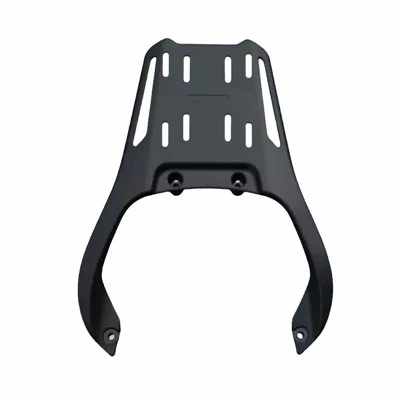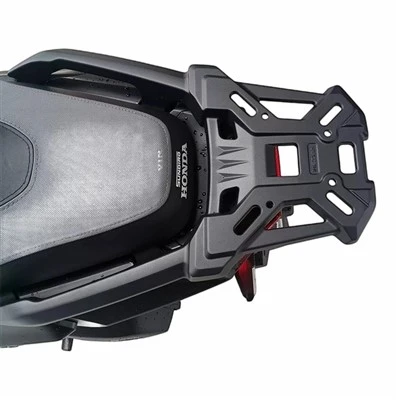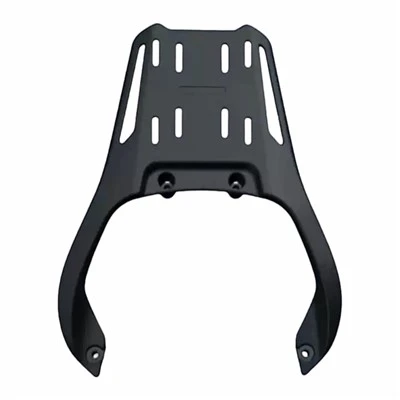

Feasibility and Methods for Repairing a Broken Motorcycle Tail Rack via Welding
Whether a broken motorcycle tail rack can be repaired through welding depends on the cause of the fracture, the material, and the welding process. For steel tail racks that have fractured due to localized stress but retain their overall structural integrity, argon arc welding (TIG welding) can be used to achieve a strength 120%–150% of the original factory specification. For aluminum alloy tail racks, or cases involving design flaws or material fatigue, replacement or reinforcement is recommended.
Conditions Suitable for Repair via Welding
If a fracture is caused by localized stress concentration or minor overloading-and the main structure of the tail rack remains intact (common in steel tail racks)-it can be repaired using argon arc welding. The fracture surfaces must be ground smooth; the weld penetration should reach at least two-thirds of the base material's thickness, and the weld bead must be continuous and free of porosity. For load-bearing areas, a "fish-scale" welding technique should be employed. Additionally, internal reinforcement (such as welding on stainless steel plates or adding stiffening ribs) or external support (such as installing triangular support brackets to distribute stress) can be used to restore or even exceed the original factory strength.
Situations Requiring Caution
Aluminum Alloy Tail Racks: These are difficult to weld; post-repair strength is typically only 60%–70% of the original, and they are prone to intergranular corrosion. Replacement with a carbon steel or stainless steel component is advised.
Design Flaws: If the tail rack suffers from issues like single-point mounting or excessively thin tubing walls, welding alone will not solve the root cause. In such cases, additional support plates must be installed, or the unit should be replaced with a high-strength alternative.
Material Fatigue: If a fracture recurs in the same location, it indicates material fatigue. Welding is merely a temporary measure; the part should be replaced as soon as possible.
Verification Methods After Repair
Static Testing: The rack should be able to support 1.5 times its rated load for 24 hours without any deformation.
Dynamic Testing: When traversing road features such as speed bumps, the top case (or luggage) should remain stable without wobbling or producing abnormal noises.
Non-Destructive Testing (NDT): Critical welds should undergo X-ray inspection to ensure there are no internal defects.